
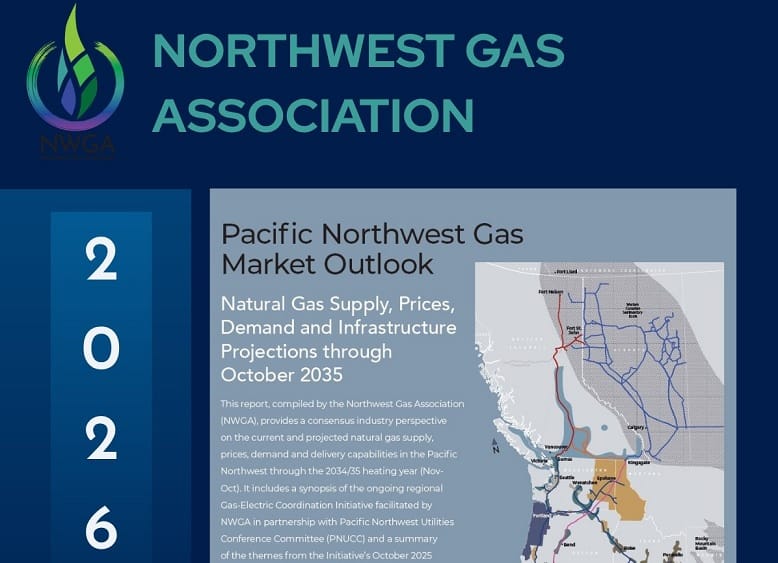
July 9, 2026. The Northwest Gas Association (NWGA) released its 2026 Pacific Northwest Gas Market Outlook (Outlook), a comprehensive assessment of natural gas supply, prices, demand, infrastructure and emerging energy challenges across British Columbia, Idaho, Oregon and Washington.
The report arrives at a pivotal moment for the region as policymakers, regulators, utilities, businesses and ratepayers confront a rapidly changing energy landscape marked by rising energy demand, replacing existing power generation with renewable alternatives, growing reliance on natural gas-fired generation for meeting peak demand, increasing electrification, large electricity consumers and mounting infrastructure constraints.
Released under the theme “Let’s Get Real About Energy,” the Outlook calls for a pragmatic, fact-based conversation about how the Pacific Northwest can continue delivering reliable, affordable and lower-carbon energy while meeting growing demand.
“The energy conversation has evolved,” said Kelly Fukai, Chief Executive Officer of the Northwest Gas Association. “This is not a gas versus electricity debate. It’s about understanding the realities of the energy system we have today and the one we’re building for tomorrow. The Pacific Northwest is entering a new era of energy demand, and reliability, affordability and sustainability must advance together.”
Among the report’s key findings:
- Natural gas remains a critical direct-use energy source for nearly 10 million residents, 3.7 million households, and 350,000 businesses across the region.
- Regional natural gas demand is expected to grow modestly overall, with important differences by jurisdiction, customer class, and season.
- The electric grid is relying more on natural gas-fired generation as coal resources retire, renewable resources expand, and peak demand grows.
- The January 2024 multi-day cold snap highlighted the region’s exposure to energy supply shortfalls and made clear that natural gas and electric systems are deeply interconnected and must be planned together.
- Major natural gas pipelines and storage facilities are already operating near capacity during winter peaks, limiting flexibility during prolonged severe weather.
- Renewable natural gas, hydrogen, energy efficiency, and infrastructure modernization can reduce emissions while helping preserve reliability and affordability.
The Outlook also highlights the work of the joint NWGA-Pacific Northwest Utilities Conference Committee (PNUCC) Gas-Electric Coordination Initiative, which was launched following the January 2024 cold weather event to enhance natural gas and electric coordination and raise awareness about the increasing interdependencies. The initiative brings together electric utilities, natural gas utilities, pipelines, power producers and regional energy organizations to strengthen operational coordination, align planning assumptions, and improve communication.