
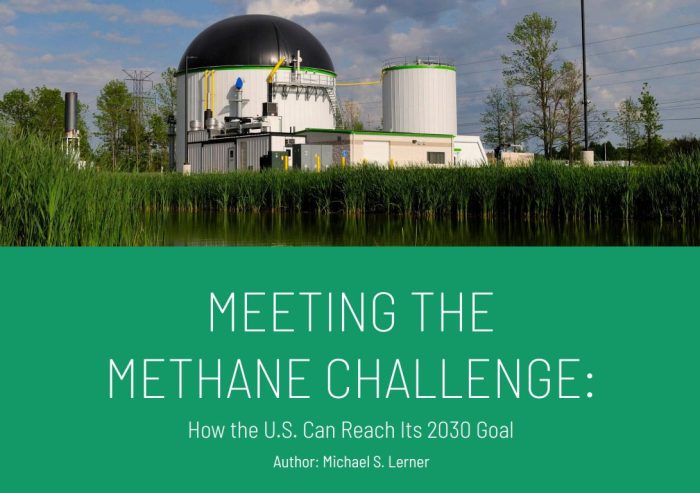
May 18, 2024. The non-profit Energy Vision published its report, “Meeting the Methane Challenge: How the U.S. Can Reach Its 2030 Goal.” The title refers to the Global Methane Pledge, which commits the U.S. and 154 other signatories to the goal of cutting methane emissions at least 30% by 2030 (or “30×30” for short) to keep global warming within 1.5 degrees Celsius and prevent the worst effects of “runaway” climate change. Methane is 87 times more potent as a greenhouse gas than carbon dioxide over 20 years, and it has already caused a third of modern global warming.
On May 7, EPA’s New Source Performance Standards (NSPS) for oil and gas production took effect, tightening methane regulations across millions of pieces of equipment. Energy Vision’s report assesses NSPS and a range of other current and potential measures to cut methane emissions in the U.S. oil and gas sector, such as plugging abandoned oil and gas wells and “stripper wells,” which produce very little oil and gas but collectively have high methane emissions. Of these various oil and gas measures, NSPS has the greatest potential impact, the report finds. According Energy Vision’s analysis, if fully implemented by 2029, the NSPS would cut U.S. methane emissions by 17.5%.
But that is little more than halfway to the 30×30 goal. The report lays out a data-driven roadmap for a complementary strategy which could go the rest of the way to meeting or exceeding 30×30 cost-effectively, and which deserves more attention: anaerobic digestion of organic waste.
Food waste and agricultural manure release methane biogases as they decompose, but instead of escaping into the atmosphere, these biogases can be captured in sealed tanks called anaerobic digesters (ADs) and converted to renewable energy.
Building more ADs is a practical, cost-effective path to cutting U.S. methane emissions by another 13.6% by 2030 while producing renewable energy, the report finds. Methane biogases captured in ADs can be used to generate local power and heat, for example to run dairy operations. Or they can be refined into renewable natural gas (RNG), the lowest-carbon fuel available today. RNG fueI is especially beneficial when used in applications which can’t readily be electrified: older homes and buildings, heavy industries, and heavy-duty trucks and buses.
RNG is chemically similar to fossil natural gas and can be used in all the same ways. But unlike fossil gas, RNG made in ADs involves no fracking or other leaky extraction, and has drastically lower carbon emissions. In fact, when made from food scraps or manure, it is “net carbon-negative” on a lifecycle basis. This means more greenhouse gas emissions are captured during fuel production than are emiged when the fuel is burned – a big net gain for the climate.
Energy Vision’s report finds that the “biggest bang for the buck” in organic waste methane abatement is keeping food waste out of landfills and processing it in ADs. Landfills are major methane emigers, and food waste accounts for most of those emissions. Half of all food currently discarded as waste is edible and should be redistributed. But the other, inedible half is an ideal feedstock for ADs. The second biggest “bang” is processing farm manure in ADs, which lowers agricultural methane emissions and provides crucial extra income for medium-sized farms.
According to Energy Vision’s analysis, building some 700 new ADs to process municipal and industrial food waste as well as about 4,000 new ADs to process dairy and swine manure would cut U.S. methane 13.6%. The total capital cost of the 4,700 digesters would be about $74 billion, some of which available in tax credits and other financing under the Inflation Reduction Act (IRA). New digesters take two to six years per project to build and could be operational by 2030.