
February 25, 2026. New data released by the American Biogas Council (ABC) shows that 2025 was another strong year for the U.S. biogas industry. In the 12 months ending December 2025, 70 new biogas projects came online, representing more than $2 billion in new, domestic, recycling infrastructure and pushing the total number of U.S. systems capturing biogas from organic waste to nearly 2,600 facilities nationwide.
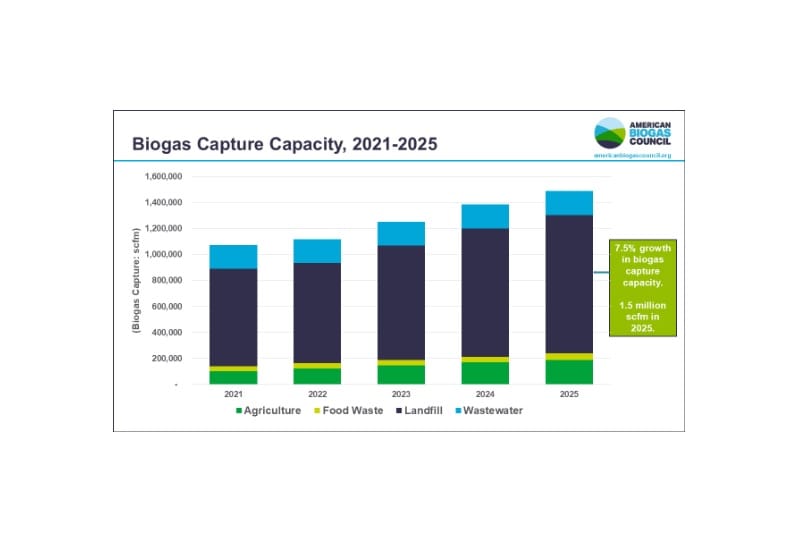
Industry-wide biogas capture capacity increased by 7.5% in 2025, reaching 780.7 billion cubic feet (Bcf) per year—approximately 1.5 million standard cubic feet per minute (scfm).
“Biogas continues to prove its value as a practical, scalable solution for America’s energy and waste challenges,” said ABC Executive Director Patrick Serfass. “In an era of rising energy demand, increasing interest in domestic manufacturing and the drive for energy dominance, biogas delivers the reliable, around-the-clock energy source America needs while reducing transportation pollution, improving our soil and food supply, and turning waste into valuable products.”
Landfill gas (LFG) projects, which capture the biogas produced as organic material decomposes in landfills, continue to represent the majority of U.S. biogas captured. Despite comprising fewer facilities than farm-based and wastewater systems, LFG facilities account for 72% of all biogas captured nationwide. In 2025, the industry added 20 new landfill gas capture projects, bringing the total number of LFG facilities to 599, and representing $912 million in investment, or 43% of total capital that biogas developers invested in 2025 projects. LFG production capacity increased by 8% to 559 billion cubic feet (Bcf) per year.
Agriculture once again led the industry in new methane capture in 2025. Forty new farm-based biogas projects came online, the culmination of $835 million in investment in rural and exurban communities. The amount of methane-rich gas captured overall on farms increased by 11% to 99 Bcf per year.
Food-waste-only biogas projects also experienced a notable surge in 2025. Investment in the sector more than doubled compared to the prior year, reaching $325 million and driving an 18% increase in biogas capture to 28 Bcf annually. While still the smallest sector by project count, food waste systems are gaining momentum each year as more municipalities seek solutions to divert organic waste like food waste from landfills. In addition to the 124 food-waste-only biogas projects in the U.S., about 200 agriculture and wastewater facilities also recycle food waste together with manure or biosolids.
The wastewater sector remains the largest by number of facilities, with 1,232 operational systems—nearly half of all U.S. biogas sites. Growth in the sector was modest in 2025, reflecting its maturity and long history. The oldest biogas facilities in the country, dating back to the 1920s, and operating for more than 100 years, are located at wastewater treatment plants.
Of the 70 new biogas projects that came online in 2025, 68 were designed to upgrade biogas to RNG for use as vehicle fuel. As a result, 659 U.S. facilities now supply captured biogas for RNG production. Total RNG production rose 24% in 2025 to 225.6 million MMBtu—enough energy to fuel about 8.2 million vehicles.
Despite this growth, renewable electricity remains the backbone of the U.S. biogas industry. Approximately 75% of biogas projects and 55% of total biogas output are used to generate renewable power, underscoring the popularity of biogas-produced, reliable, renewable, ready electricity.
Biogas projects operate in every U.S. state, reflecting that organic waste is produced and poses a challenge wherever there are people or animals. Seven states each attracted more than $100 million in capital investment from biogas projects that came online in 2025: Texas, California, Illinois, Idaho, Washington, Wisconsin, and Florida. These states led the nation in new project spending strengthening local economies, supporting job creation, and advancing recycling and waste management infrastructure.