
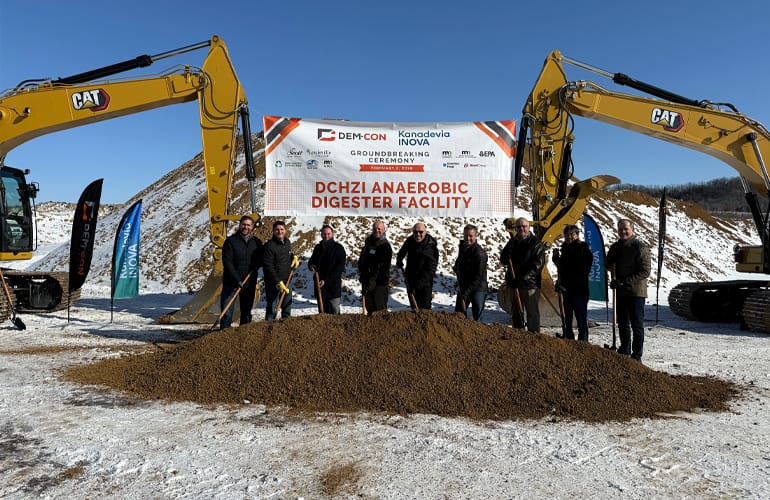
March 2, 2026. Kanadevia Inova, a global leader in waste-to-energy and renewable gas solutions, announced the official groundbreaking of the Louisville Township Renewable Gas Project, a pioneering large-scale anaerobic digestion facility located in Louisville Township, Minnesota, USA. With all key project details finalized, Kanadevia Inova’s North America team and its partners are launching one of the most advanced organic waste-to-renewable gas projects in the region and establishing a new benchmark in circular waste management and renewable energy production. The site will begin receiving organics for processing in 2027.
“This cutting-edge facility will convert the organic fraction of municipal waste from surrounding counties into renewable energy through anaerobic digestion, biogas upgrading, and advanced gasification. In addition to biomethane, it will be the first facility of its kind to produce biochar, a carbon-sequestering byproduct that reduces the plant’s carbon intensity and creates valuable applications for agriculture and industry,” Heath Jones, Regional President North America, Kanadevia Inova, said.
The Louisville Township project was born due to policy goals set by the State of Minnesota and local municipalities aiming to reduce greenhouse gas (GHG) emissions, divert a portion of landfill waste, and produce renewable energy. Once operational, the Dem-Con HZI (DCHZI) BioEnergy facility will process up to 75,000 tons of organic materials per year and convert them into valuable renewable resources. The plant is expected to produce approximately 200,000 MMBtu of renewable natural gas (RNG) annually, while also generating around 8,000 tons of biochar each year. By diverting organic waste from disposal, the project will reduce landfill volumes and create enough to power 2,700 U.S. homes year-round on average, and significantly lower greenhouse gas emissions, playing a key role in supporting Minnesota’s circular economy.
Organic waste diverted from landfill includes both source-separated organics (SSO) collected in compostable bags and organic material recovered from the biodegradable fraction of municipal solid waste (MSW). National average household waste consists of 24% food waste. That is more than any other single material and when it ends up in a landfill and if untreated, it decomposes, and the decay emits methane and CO2 into the atmosphere, two powerful greenhouse gases (GHG).