
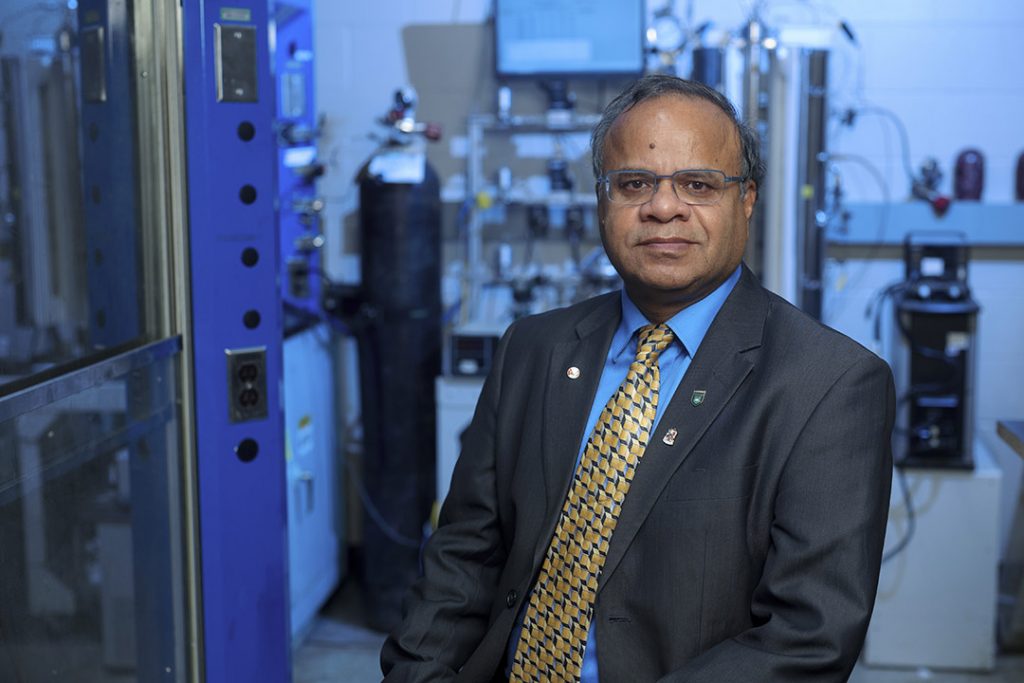
March 14, 2022. University of Saskatchewan (USask) researcher Dr. Ajay Dalai (PhD) is working with a Calgary-based industry, Tidewater Renewables, to develop a novel integrated process to produce renewable natural gas (RNG) from the biomass.
The goal is to help decarbonize the heating and power production sectors by replacing non-renewable natural gas with biomethane and help Canada’s transition to a low-carbon economy, said Dalai, a distinguished professor in USask’s College of Engineering and Canada Research Chair of Bioenergy and Environmentally Friendly Chemical Processing.
The process Dalai is developing aims to make cost-efficient biomethane from the vast volume of agricultural biomass available on the Prairies. While some of the material is used as animal feed and bedding, a lot is left in fields or hauled to landfills, where it rots and releases methane—a greenhouse gas whose impact on climate change is nearly 25 times worse than carbon dioxide.
Monetizing the carbon in biomass to produce renewable biomethane locally instead of allowing methane from decomposition to contribute to climate change is sensible, especially as it also reduces the reliance on non-renewable natural gas, Dalai said.
“The idea is to digest the residues from agriculture biomass to make methane,” he said. “We collect the methane, take the solid and gasify to get more methane. Then we take the byproduct gases from the gas we make and convert that into additional methane as well,” Dalai said.
The biomethane produced this way is identical to the methane in natural gas and can be directly injected into existing natural gas networks. Diverting the biomethane, rather than see it simply released into the atmosphere, mitigates its global warming impact.
Dalai is developing a novel integrated process that uses both biochemical (anaerobic digestion) and thermochemical (gasification) methods to produce RNG.
Tidewater is providing $150,000 annually for three years for the project. Dalai is also applying for an Alliance grant from the Natural Sciences and Engineering Research Council of Canada, which would provide $300,000 annually for the project if he is awarded funding. At least six highly qualified personnel will be trained as part of the project.