
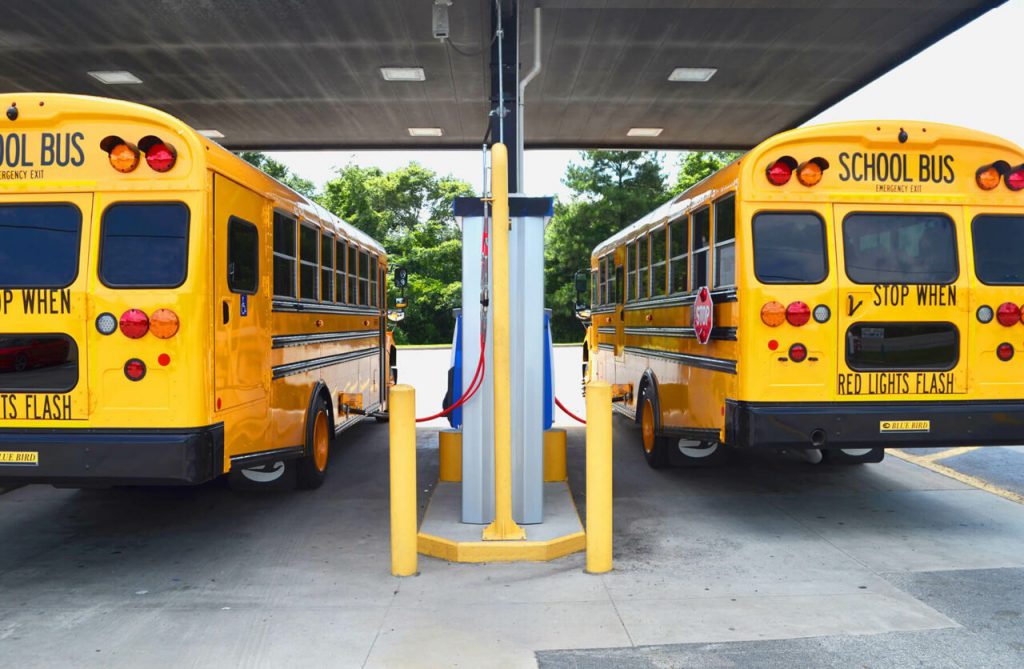
September 7, 2022. As students in Pasco County board the bus to school each morning, many are stepping aboard a science lesson on reducing greenhouse gas emissions.
It’s a science project that began in 2010 when the school district took advantage of a state grant to outfit 129 buses with diesel oxidation catalysts to help improve emissions in older buses.
In 2013, the district implemented propane-powered buses and liquefied petroleum gas (LPG) fueling stations, which now serve East Pasco. The use of propane results in up to 20% less nitrogen oxide, 60% less carbon monoxide, and 24% fewer greenhouse gas emissions.
Pasco County Schools will soon open its sixth transportation compound that will feature a fast-fill compressed natural gas (CNG) station, housing up to 90 CNG buses. Compared to the current clean diesel buses, these buses produce 13% less greenhouse gas, 95% less nitrogen oxide, and 80% less hydrocarbon.
Heavy-duty vehicles such as semi-trucks, school buses and garbage trucks account for 7% of all vehicles in America, yet they are responsible for more than 50% of all smog-precursor emissions and 20% of all greenhouse gases emitted from transportation activities.
Many organizations with utility fleets, like Pasco County Schools, have turned to CNG to effectively reduce their carbon footprint.
CNG is a natural gas that has been compressed to less than 1% of its volume and is one of the cleanest fuels available for heavy-duty vehicles.
“CNG is fast becoming a safe and viable transportation fuel alternative. When companies choose to convert their fleets to CNG, it reflects their commitment to the environment,” said Dale Calhoun, executive director of the Florida Natural Gas Association. “By making more incentives available, we can help more companies transition their fleets, which would significantly reduce greenhouse gas emissions on highways across the Sunshine State.”