
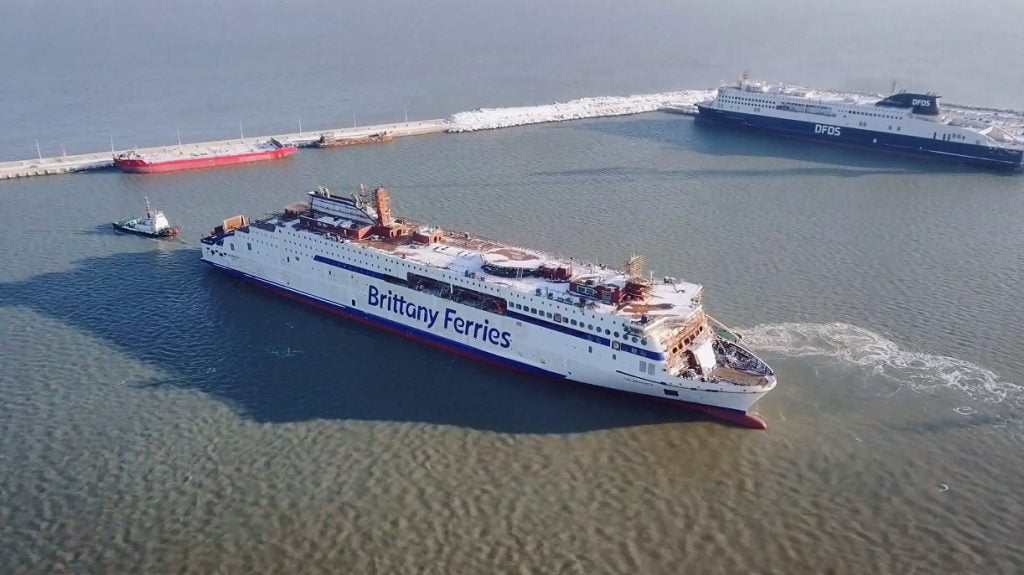
November 24, 2021. Brittany Ferries is committed to fleet renewal and energy transition. By 2025 four new ships will be added to the fleet, two powered by cleaner liquefied natural gas (LNG), followed by two LNG-electric hybrid vessels. All will replace older, less efficient ships.
The company believes LNG is the best available option currently on the market for shipping, but recognize this is a transition fuel rather than a solution to get us to net zero emissions.
LNG-powered ships are fuel-agnostic: they can be adapted to run on future fuels such as biomethane and e-methane. They can also be adapted to run on some future e-fuels derived from renewable hydrogen, if/when these become available. This means Brittany is equipping itself with the hardware (ships) and expertise (trained crew) to accommodate different types of cryogenic fuel in the future.
LNG delivers a significant reduction in air quality emissions, such as SOx, NOx and particulates. This is far better for local communities around ports, as air quality is a major contributor to respiratory illness.
It also burns more efficiently than fuels such as MGO. This means there is around 20% reduction on carbon dioxide emissions. Carbon dioxide (CO2) is a greenhouse gas.
Despite CO2 reduction benefits, the company recognize that methane slip is a concern for LNG used as a maritime fuel. Methane is also a greenhouse gas (GHG), but is far more potent than CO2.
It’s important that methane leakage is considered in terms of the lifecycle of the fuel. Well-to-tank refers to the process of extraction, transport and storage. Tank-to-wake refers to the storage on board and combustion of LNG in ships’ engines.
Brittany Ferries has a responsibility to work with partners to reduce tank-to-wake methane slip. Its engine partner Wartsila, for example, has already invested heavily, delivering engines that have reduced it by 85%. The company says further investment in areas like fuel injection and efficient combustion could further reduce methane slip by 50%.1
Several studies have examined well-to-wake GHG emissions from LNG used as a maritime fuel, taking into account a variety of scenarios. The report commissioned by the gas industry undertaken by Sphera2 suggests a reduction of up to 23%. However, even the report by UMAS3 commissioned by NGO Transport and Environment suggests a 6% (likely lower bound) to 10% reduction in GHG compared to replaced diesel fuel.
Fleet renewal and the adoption of LNG present many advantages: lower air quality emissions, better passenger comfort and adaptability for future fuels. And while methane slip must not to be ignored, LNG is already a better solution for GHG emission reduction than ships powered by diesel. Its performance will continue to improve as technology further cuts methane slip upstream in the well-to-tank phase (extraction, transport and storage), as well as from tank-to-wake.