
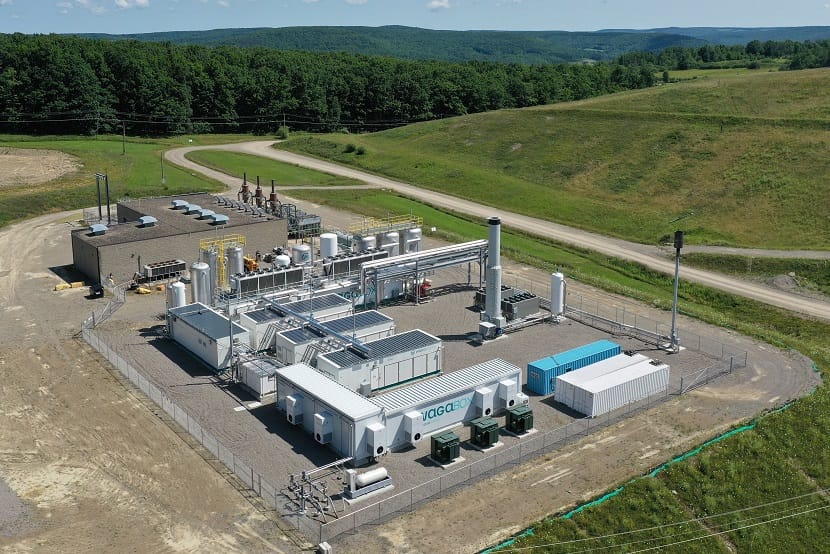
July 27, 2026. Casella Waste Systems, Inc., a regional solid waste, recycling and resource management services company in the Eastern United States, and Waga Energy, a global expert in the production of Renewable Natural Gas (RNG) from landfills, announced the start of operations of the RNG production facility at the Hyland Landfill in Angelica, New York.
The facility coming online marks another important milestone in Casella’s strategy to recover value from the waste it manages. Hyland is the second of three RNG projects developed by Casella and Waga Energy to enter operation, following the Chemung County facility.
“It is so gratifying for our team to see our fourth RNG project come online at the Hyland landfill,” said Ned Coletta, President and CEO of Casella Waste Systems, Inc. “Several years ago, we made the strategic decision to work with RNG experts to develop the capacity at our landfills, and we have not been disappointed about our decision to partner with Waga Energy. Their entire team has collaborated effectively with our team to bring these projects online within a tight timeline, and their innovative technology is performing well at each landfill.”
The facility uses Waga Energy’s patented WAGABOX® technology to upgrade landfill gas into pipeline-quality RNG. With 3,000 SCFM of installed processing capacity, Hyland can generate up to 610,000 MMBtu (180 GWh) of renewable gas annually, making it one of the largest RNG production units in Waga Energy’s U.S. portfolio.
“The commissioning of a large-capacity WAGABOX® unit at the Hyland facility demonstrates the scalability of our technology and its ability to produce RNG from landfill sites of various sizes,” said Guénaël Prince, Chief Executive Officer of Waga Energy Inc. “It is also the second project developed with Casella to enter operation this year, reflecting the strength of our partnership and our shared commitment to turning landfill gas into a reliable source of renewable energy.”
The RNG produced on-site is injected directly into the Eastern Gas Transmission and Storage network, supplying the region with a renewable alternative to fossil natural gas. The project is expected to avoid 47,000 tons of CO2-equivalent emissions each year, according to U.S. Environmental Protection Agency (EPA) standards.