
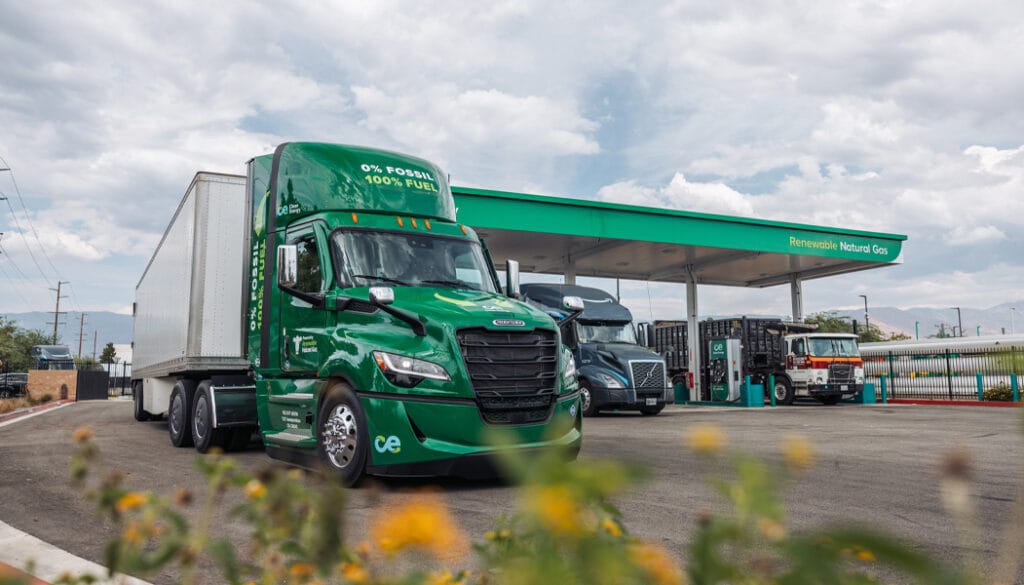
June 30, 2026. Last calendar year marked the sixth consecutive year that commercial fleets in the State of California fueled by Bio-CNG achieved a carbon-negative transportation outcome, according to a report released by The Transport Project (TTP), RNG Coalition, and California Renewable Transportation Alliance (CRTA).
Renewable natural gas (RNG) accounted for 98% of all on-road fuel used in natural gas vehicles in California in 2025, driven by the state’s successful Low Carbon Fuel Standard (LCFS) program. According to data from the California Air Resources Board (CARB) the annual average carbon intensity score of Bio-CNG in that mix was -198.32 gCO2e/MJ.
In fact, Bio-CNG holds the lowest average carbon intensity of any clean fuel option on California’s roadways today and is the only fuel producing a negative carbon intensity fleet outcome in the California Low Carbon Fuel Standard (LCFS) Program, which includes ethanol, biodiesel, renewable diesel, Bio-CNG, Bio-LNG, electricity, alternative jet fuel, and hydrogen.
Even more, while RNG made up just 6% of all on-road alternative fuels dispensed by volume under the California LCFS in 2025, it generated 25.3% of all carbon dioxide equivalent (CO2e) emission reductions of on-road alternative fuels reported.
Captured above ground from organic material in agricultural, wastewater, landfill, or food waste, RNG can produce carbon-negative results when fueling on-road vehicles like short- and long-haul trucks, transit buses, and refuse and recycling collection vehicles.
“When used as a transportation fuel, RNG displaces gasoline and diesel in applications that are difficult – if not virtually impossible – to electrify,” said Daniel Gage, President of The Transport Project. “Renewable natural gas offers the most immediate, cost-effective, and scalable way to deploy clean trucks and buses and significantly reduce greenhouse gas and criteria pollutants… and it does so without upending existing business operations.”
The groups report that in 2025 a total of 227.83 million gallons (DGE) of natural gas were used as motor fuel in the state. Of that, 222.71 million gallons (DGE) were from renewable sources. Even more, 21.9% of all RNG motor fuel used in-state was produced in-state, up from just 6.74% in 2021, and the overwhelming majority is from agricultural operations.
“Renewable Natural Gas (RNG) continues to decarbonize heavy-duty trucking in California and beyond amid historic growth of RNG facilities across North America,” said RNG Coalition’s Sam Wade, VP of Public Policy. “On the demand side, RNG use in California has grown 28% over the last five years, displacing millions of tons of greenhouse gas emissions due to support from the state’s Low Carbon Fuel Standard. With 98% of natural gas vehicles in California operating on RNG, the challenge before us is to accelerate the conversion of diesel engines to those fueled by RNG, so these benefits are extrapolated across all medium- and heavy-duty fleets in the State, and beyond.”
In addition to their negative greenhouse gas (GHG) emissions, ultra-low NOx medium- and heavy-duty RNG-fueled trucks and buses perform at levels that are 90% below the federal nitrogen oxide (NOx) standard and 90% below the federal particulate matter (PM 2.5) standard. NGVs virtually eliminate criteria pollutant emissions that contribute to asthma, heart disease, and poor air quality.
Investing in RNG-fueled trucks and buses provides policymakers the most cost-effective way to achieve significant emissions reductions from commercial transportation sources today. With $100 million in grant funding covering the full price of new clean vehicle purchases, investing in RNG-fueled Class 8 trucks delivers six times more greenhouse gas and two times more criteria pollutant emissions reductions than deploying similar battery electric trucks. If $100 million in new truck grants covered just the incremental truck purchase cost over legacy diesel, RNG investments deliver 12 times more greenhouse gas and 3.5 more criteria pollutant emissions reductions than battery electric, deploying 1,333 RNG trucks versus just 357 battery electric trucks.
“Renewable natural gas is a proven, scalable solution helping California advance its clean truck goals,” added Nicole Rice, President of the California Renewable Transportation Alliance. “It delivers immediate environmental benefits and supports fleets today, while complementing the broader shift to zero-emission technologies. We support a technology-neutral approach that embraces all pathways to cleaner air and lower emissions. RNG is ready now and plays a vital role in achieving a sustainable clean truck transition. We’re proud to support policies that drive meaningful progress.”
Unlike developing heavy-duty ZEV options including battery electric and hydrogen, RNG-fueled trucks and buses have access to an established California public fueling infrastructure and a mature network of servicers and suppliers. RNG trucks are affordable and scalable, meeting range and operations requirements for any commercial medium- and heavy-duty application. And RNG fueled trucks and buses do not rely on components sourced and controlled overseas.