
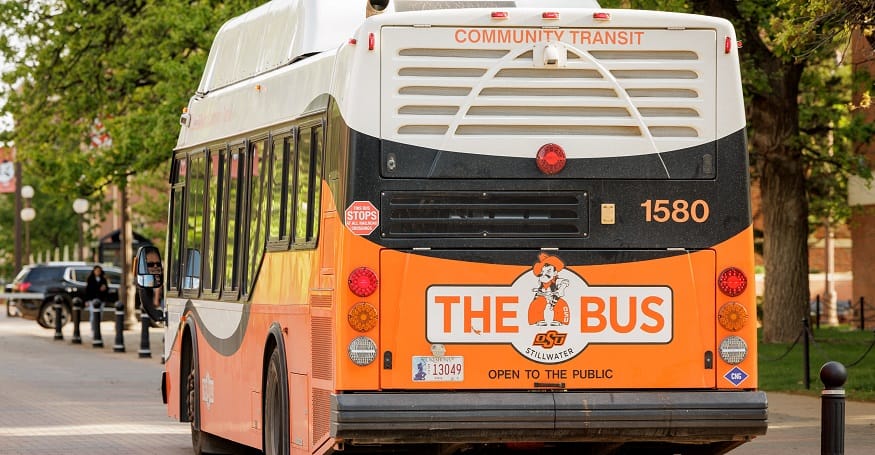
June 6, 2026. Oklahoma State University has announced a new 10-year partnership with Love’s Alternative Energy, a member of the Love’s Family of Companies for the operation, maintenance and renewable fuel supply of OSU’s compressed natural gas (CNG) bus fueling station.
The contract, which takes effect May 28, marks a significant step forward in OSU’s ongoing commitment to sustainability and cleaner campus transportation. OSU has been committed to CNG as a transportation fuel for the bus fleet since 2009.
The CNG fueling station serves OSU’s fleet of 27 transit buses, which provide transportation not only across the Stillwater campus but also throughout the broader Stillwater community. Under the new agreement, Love’s Alternative Energy will replace aging compressor equipment, assume full operations and maintenance responsibilities, and supply renewable natural gas (RNG) — a cleaner-burning fuel derived from organic waste sources such as landfills and agricultural byproducts.
Located at the corner of Western and Lakeview roads, the station handles approximately 150,000 diesel gallon equivalents (DGE) of fuel per year. By transitioning to RNG, OSU will qualify for benefits under the U.S. Environmental Protection Agency’s Renewable Fuel Standard (RFS) program. Under the RFS, the university will earn Renewable Identification Numbers (RINs) — tradeable credits that can generate revenue for the university, effectively allowing OSU to be compensated for choosing a renewable energy source.
Steve Spradling, director of OSU’s Parking and Transportation Services, said the university is excited to continue its sustainability efforts with RNG through Love’s Alternative Energy.
“Our partnership with Love’s represents a major step forward in continuing to provide clean, reliable transportation for our community,” Spradling said. “By investing in our CNG infrastructure for our transit fleet, we’re not only reducing emissions and operating costs, but also demonstrating a commitment to sustainable practices benefiting Oklahoma State University and the community for years to come.”